
Lead-acid batteries are the most widely used types of industrial batteries in backup systems, UPS, automotive, and solar energy. These batteries have been used in various industries for years due to their reasonable price, long lifespan, and reliability.
But the key to the performance of these batteries is how they are charged and discharged. One of the most important factors affecting the performance and lifespan of these batteries is the discharge rate (C-rate), which has an inverse relationship with usable capacity.
Relationship between discharge rate and battery capacity
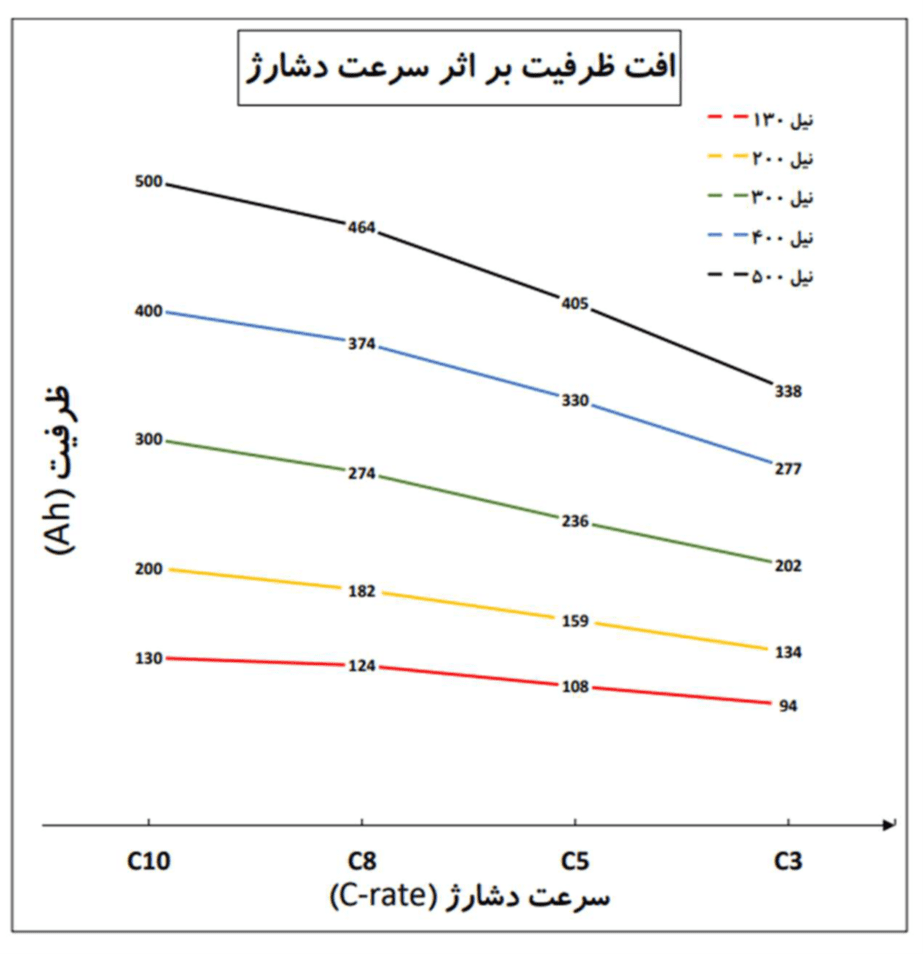
In lead-acid batteries, there is an inverse relationship between discharge rate and output capacity.
That is, the higher the discharge current, the lower the usable capacity of the battery.
Simply put, when a battery is discharged in a shorter period of time, it cannot deliver its full rated capacity.
This occurs due to the limitations of electrochemical reactions within the cells. During rapid discharge, the active materials do not have enough time to react completely, so some of the energy inside the battery remains unusable.
Tests conducted on Nile Batteries (NILE)
Tests conducted by the Platinum Iran Company R&D unit on Nile brand lead-acid batteries have shown that increasing the discharge rate causes a noticeable drop in capacity.
For example, when the discharge mode changes from C10 to C3, the output capacity decreases by about 30 percent.
The effect of discharge rate on Battery life
- Increasing the discharge rate does not only reduce the battery capacity, It also reduces its useful life.
- In fast discharge, the internal temperature of the cells increases, which exacerbates lead plate corrosion and reduces battery life.
- In systems where stability and long life are important, such as UPS systems, it is recommended to use lower rate discharges to increase battery life.
How to choose the best discharge rate?
Choosing the appropriate discharge rate depends on the type of application, battery capacity, and power consumption.
For systems that require high instantaneous power (such as engine starting or heavy instantaneous loads), fast discharge is acceptable.
But in applications such as backup systems such as UPS, C10toC20 slow discharge provides the best performance.
Practical tips for better operation
- Design the battery discharge rate according to the type of consumption.
- Avoid unnecessary rapid discharge.
- If high current is required, use batteries with higher capacity.
- Control the ambient temperature to prevent internal temperature from increasing.
- Use reputable brands such as NILE that have stable performance at different discharge speeds.
Summary
Discharge rate is one of the key factors in the performance, capacity, and lifespan of lead-acid batteries.
The faster the discharge, the lower the output capacity and the higher the internal wear.
Therefore, in the design of electrical and industrial systems, paying attention to the appropriate discharge rate and selecting a battery with sufficient capacity will increase the efficiency and lifespan of the battery.
NILE industrial batteries, with their precise design and high resistance, have shown stable performance at different discharge rates and are a reliable option for industrial applications.
Frequently Asked Questions (FAQ)
1. What is discharge rate (C-rate)?
C-rate indicates the battery’s discharge rate. For example, C10 means the battery will be fully discharged in 10 hours, while C3 means full discharge in 3 hours.
2. Does rapid discharge damage the battery?
Yes, rapid discharge in addition to Capacity, causes temperature increase and corrosion of the internal plates of the battery, which shortens its life.
3. What is the best discharge rate to extend the life of the battery?
In lead-acid batteries, discharge in the range of C10 to C20 creates a good balance between output capacity and increased life.